
How do you count points on a buck? Count qualifying projections on each antler, including the main-beam tip, then state the count for each side. Under Boone and Crockett instructions, a projection must meet the one-inch length and length-versus-width requirements. A photo can suggest a count, but cannot prove the size of a small or hidden projection.
What counts as a point?
A visible bump is not automatically a qualifying point. The official chart specifies a minimum length of one inch and a width test: the projection’s length must exceed its width at one inch or more of length. Use the chart’s instructions to check borderline projections on the physical rack; do not decide from a blurred image.
| Part of the rack | Count it? | How it enters measurement |
|---|---|---|
| Main-beam tip | Yes | Already included in main-beam length; do not add a separate G measurement. |
| Brow tine | When it qualifies | Usually the first normal point, G1. |
| Other normal tine | When it qualifies | Record its correct normal-point measurement. |
| Abnormal projection | When it qualifies | Record separately from normal points. Category rules affect its treatment. |
| Small bump or obscured projection | Do not assume | Inspect and measure; mark uncertain in a photo observation. |
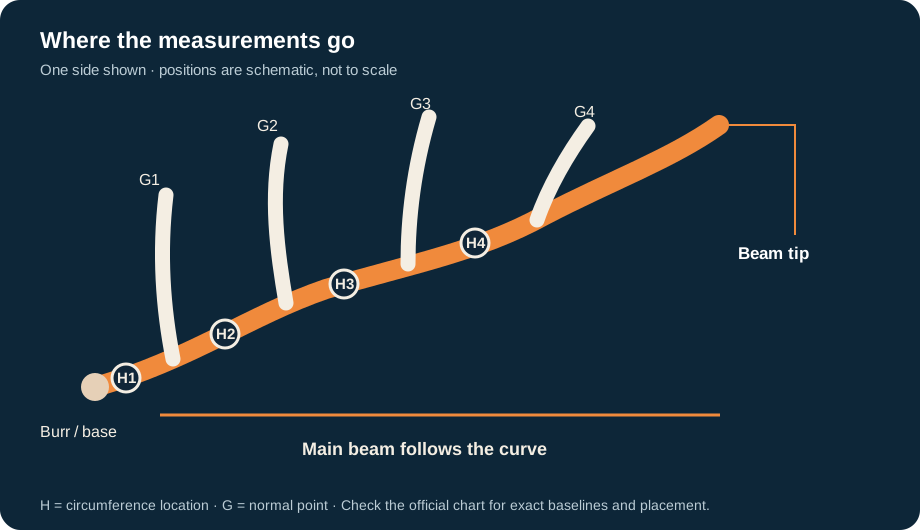
Count each antler separately
- Identify the deer’s left and right antlers. In a head-on photograph, the deer’s left is on your right.
- Follow one main beam from its base to its tip, noting every qualifying projection.
- Include that beam tip once. Repeat on the other antler.
- Record both side counts and the total. Note uncertainty instead of inventing a hidden point.
Hunters use different shorthand, so “five left, four right; nine total” is clearer than a label without an explanation. Use the animal’s own sides consistently in your notes and calculator entries.
Simple counting examples
Four normal tines plus a beam tip
That makes five points on one antler if each tine qualifies. The same arrangement on both sides gives ten total. There are still only four normal-tine entries per side, because the beam tip is not a separate tine measurement.
Different counts left and right
Five qualifying points on the left and four on the right give nine total. Do not add an unseen point simply to make the rack symmetrical. A missing or hidden point needs inspection, not an assumption.
These are constructed counting examples, not counts taken from our AI-generated buck illustration.
What a photograph cannot settle
One antler can overlap the other, and a tine can disappear behind an ear or branch. A second angle can clarify visible structure, but neither angle necessarily establishes whether a short projection meets the physical qualification rule.
Record a visible count with a note such as “right side partly hidden” where needed. Do not use generative editing to reveal antlers; it creates an illustration, not new evidence. Our trail-camera guide explains how to choose the clearest original frame.
Why a ten-point buck does not have one fixed score
Point count alone omits beam lengths, spread, point lengths and mass. Two bucks with the same point count can have substantially different measured totals. You cannot convert “eight points” or “ten points” into a reliable antler score without more information.
With the rack in hand, follow our measurement guide and enter the lengths in the manual calculator. With only a clear picture, photo scoring provides an estimate—not a certified measurement.
By RackScore. Measurement reference checked September 27, 2026: Boone and Crockett Club typical whitetail score chart and instructions. Consult an Official Measurer for ambiguous point classification. RackScore is independent and is not endorsed or certified by the Club.